Rural Health Transformation Program
Reach rural patients where broadband doesn't. Show what your RHTP funding produced.
Lightbeam helps rural hospitals, health centers, ACOs, and regional networks reach patients on any phone, connect data and care across providers, and measure what changed, with the analytics and financial modeling to help sustain results beyond the grant.
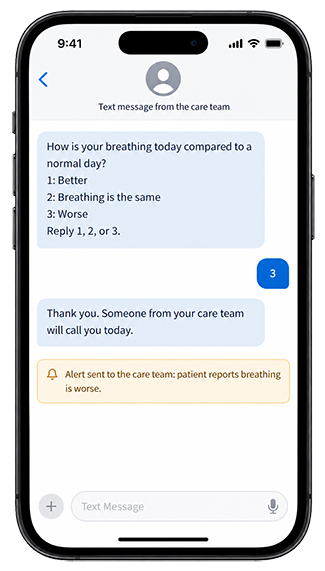
CareSignal turns simple text and voice into remote patient monitoring.
No app, smartphone, or broadband required.
The work lands with the organizations it funds.
beyond the clinic
Rural patients may lack reliable broadband, smartphones, transportation, or consistent access to care. Reaching them between visits is often where the program succeeds or fails.
teams and systems
RHTP initiatives often span hospitals, clinics, specialists, community partners, and multiple EHRs. The challenge is connecting the data and workflows well enough to know who needs action and who is responsible.
Awardees need to establish baselines, track clinical and utilization outcomes, and show what the investment changed, all while building a model that can continue after the grant ends.
Reach patients. Connect care and data. Measure what changed. Sustain what works.
CareSignal gives care teams a scalable way to monitor and engage patients without requiring an app, smartphone, or broadband connection. Patients respond by text or automated call on the phone they already have, while risk-based alerts help care teams focus on the patients who need follow-up.
1
Engagement specialists contact and enroll patients on your behalf, so your clinical team can focus on care.
2
Questions for diabetes, hypertension, COPD, heart failure, asthma, behavioral health, and more, from over 30 clinically validated programs.
3
Responses are sorted by risk, and your team is alerted when a patient’s answers call for follow-up.
4
Care managers spend their day on the patients who need them most.
Medical assistant at a Texas Association of Community Health Centers member health center
53%
six-month engagement across chronic disease programs at OSF HealthCare, compared with under 1% for a Medicaid health app
78%
of patients still engaged after 10 months across five Americares free clinics
1.4%
of patients alerting on a given day at TACHC health centers, a workload staff can plan around
Already using connected devices? Lightbeam can work alongside device-based RPM, adding patient outreach, risk prioritization, data integration, and ongoing engagement between readings.
modeling to show what's working
Lightbeam’s AI-ready data orchestration platform brings claims, EHR, ADT, and social-needs data into a longitudinal patient record across participating providers and care settings. Risk stratification helps care teams see who needs action first while giving network leaders a common view of performance.
Syntax adds the actuarial and financial modeling that connects clinical performance to utilization, cost, and long-term sustainability.
RHTP funding is time-limited. Lightbeam helps organizations use the data and operating model they build today to prepare for value-based arrangements that can sustain successful programs beyond the grant.
Already run an analytics platform? Lightbeam adds the deviceless outreach and financial modeling on top of what you have.
EHRs integrated
50+
Health plans supported
270
Claims processed
5 billion
Clinical data elements aggregated
13 billion
Every state funds a different mix of priorities. Lightbeam aligns to eight of CMS’s 11 approved-use categories, but the right fit depends on your state’s approved plan and the initiative your organization was actually funded to deliver
Risk stratification, care management, and condition programs that identify and support rising-risk patients.
Deviceless remote patient monitoring by text message and automated call.
Implementation support, workflow design, and managed patient enrollment.
One data foundation for claims, clinical, ADT, and social-needs data.
Financial and feasibility modeling that informs service-line decisions.
PHQ-9 and GAD-7 screening with ongoing behavioral health engagement.
Value-based care readiness, contract modeling, risk adjustment, and quality measure performance.
One engagement, data, and measurement layer across a network of providers.
Letters match CMS’s approved-use categories. Whether a specific purchase is allowable depends on your state’s approved plan and the terms of your subaward.
How each category can fund patient engagement, data, and measurement, in CMS’s own language.
We help you scope a fundable project, build the business case, and define how success will be measured, then give you the data and analytics to demonstrate impact after implementation.
Go in able to say what the project will produce and how you’ll show it, not just what you want funded.
- The solution, implementation scope, and investment defined
- A business case built with Syntax across quality and outcomes, total cost of care and utilization, and operational efficiency
- Baselines, KPIs, targets, and a clear way to measure success
- A plan to sustain the program after the grant, including value-based care readiness
We help you establish baselines and demonstrate what the funding produced.
- Patient enrollment handled on your behalf, plus care-team training
- The agreed measures monitored against your baseline
- Impact quantified, with evidence to support your required reporting
13 health centers, 2022 to 2023
1,400 patients engaged, with 60% engagement at eight months. Patients above a 9% baseline saw a 1.30-point average eHbA1c reduction, and average systolic blood pressure fell 8.28 mmHg.
15-hospital system in Illinois’ Medicaid transformation program
17,000 Medicaid patients enrolled and 53% six-month engagement. Patients above a 9% baseline saw a 2-point average HbA1c drop, and nurses responded to high- and rising-risk alerts in under an hour on average.
Florida Medicaid health plan, measured against a control group
Engaged asthma members had 22% fewer ED visits, while the control group had 4% more. 82% of engaged hypertension members were at blood pressure control, compared with 63% in the control group.
Five grant-funded free clinics in four states
78% of patients still engaged after 10 months, and 2,053 social needs identified, including 1,066 food needs.
Prescriptive AI for proactive outreach
A 4% reduction in avoidable admissions and nearly $2 million in avoided costs.
A 15-minute conversation about your state’s RHTP plan, where your organization is in it, and where Lightbeam can help.
- Which of your state’s initiatives Lightbeam can support
- How to build the business case and measures before you apply
- What deviceless monitoring would look like for your patients
- How we’d help you show results after the award
CMS lists consumer-facing technology for chronic disease, and training and technical assistance for remote monitoring, among the approved uses of RHTP funds. Its example Remote Care Services initiative includes patient engagement software. Whether a specific purchase is allowable depends on your state's approved plan and your subaward terms.
Patients answer check-ins by text message or automated phone call on the phone they already have, including basic cell phones and landlines. There's no app to download, no device to ship, and no internet connection needed.
Yes. Lightbeam helps you define the solution, implementation scope, and investment. Syntax builds the business case across quality and outcomes, total cost of care, and operational efficiency, and helps you set baselines, KPIs, targets, and how success will be measured. Your organization writes and submits its own application.
We establish your baseline, monitor the measures you agreed to, and quantify impact using the Lightbeam platform, giving you evidence to support your required reporting. Your organization remains responsible for its reporting to the state.
Yes. Lightbeam can add deviceless outreach and financial modeling on top of the analytics you already run.
Our engagement specialists handle patient enrollment, and alerts are sorted by risk so your team focuses on the patients who need follow-up. At TACHC health centers, 1.4% of patients alerted on a given day.
Eight of CMS's eleven: prevention and chronic disease, consumer technology, training and technical assistance, IT advances, appropriate care availability, behavioral health, innovative care, and regional partnerships.
Rural and critical access hospitals, FQHCs, rural health clinics, free clinics, primary care associations, clinically integrated networks, ACOs, and Medicaid health plans.
Yes. CareSignal does not replace a connected-device component when your state or funded initiative specifically requires one. Lightbeam can work alongside device-based RPM to add patient outreach, automated check-ins, risk prioritization, data integration, and ongoing engagement between readings.
Yes. Lightbeam can bring data from multiple EHRs and care settings into a common population-health foundation while supporting shared engagement, analytics, and measurement across participating organizations. The operating model can be configured around the needs of the network and its members.